



Liberica Coffee Plant: 7 Powerful Facts for Better Insight
Coffee researchers track species to support crop resilience and flavor diversity. This guide outlines taxonomy, habitats, cultivation needs, and market roles. It explains traits that separate Coffea liberica from other species. It presents clear definitions and stepwise explanations. It avoids hype and unclear claims. It uses stable terms and verified concepts. It mentions the liberica coffee plant within an evidence-led framework.
Breeding projects evaluate disease tolerance, vigor, and cup outcomes for future demand. This article assembles structured facts for agronomy planning and sourcing. It classifies main features and clarifies growth conditions. It highlights trade channels and quality control practices. It also lists environmental limits and management steps. Consequently, the liberica coffee plant appears within a precise, neutral context.
Contents
What Is the Liberica Coffee Plant?
The species Coffea liberica belongs to the Rubiaceae family and Coffea genus. Researchers recognize it as distinct from arabica and robusta. It bears larger leaves, taller stems, and bigger cherries. It shows particular adaptation to hot, humid zones. It supports shade and windbreak strategies. Therefore, the liberica coffee plant occupies a defined niche in cultivation systems.
Taxonomists place several varieties under this species label. Field observations note variable tree architecture across regions. Breeders monitor fruit size, seed shape, and flower density. They document differences in maturation pace and seed-to-fruit ratio. They record root vigor and bark texture as well. Thus, the plant holds measurable traits within standard descriptors.
Where the Liberica Coffee Plant Grows Best
Coffea liberica thrives in equatorial and subequatorial zones with stable warmth. It tolerates low to mid elevations. It prefers high humidity and gentle air movement. It handles coastal influence better than arabica. It requires stable rainfall distribution or irrigation. Under those settings, the liberica coffee plant supports viable orchard plans.
Cultivators select sites with minimal frost risk and moderate wind exposure. They consider access to water storage and shade sources. They protect young trees from dry gusts and salt spray. They manage canopy layers for airflow and light control. They monitor temperatures during flowering and fruit set. Under such management, the liberica coffee plant performs consistently.
Physical Characteristics of the Liberica Coffee Plant
Botanists regard this species as important for breeding and system design. It offers a contrasting morphology to arabica and canephora. Its architecture supports windbreak and shade layers. Its organs show identifiable dimensions. These dimensions enable rapid field identification and inventory control. Because of these features, the plant remains valuable for genetic portfolios.
Researchers document each organ using standardized descriptors and scales. They compare leaf metrics, internode length, and stem girth. They note fruit and seed geometry across stages. They inspect flower structure and calyx forms. They record bark patterns and root spread. Due to such records, the liberica coffee plant presents consistent, verifiable profiles.
Tree Height and Architecture
Mature trees reach substantial height under favorable inputs and spacing. Managers prune to maintain harvest reach and crown balance. The main stem grows upright with sturdy branching. Internodes appear longer than those in robusta. The crown forms an oval to irregular outline. Hence, teams plan ladders, platforms, and training systems for safe handling.
Leaf Dimensions and Texture
Leaves show considerable length and sustained width across age classes. The surface displays evident veins and firm lamina. Petioles hold a reliable angle from the stem. The blade resists tearing under gentle handling. Margins present smooth lines without deep serration. Consequently, scouts use these aspects to distinguish Coffea liberica coffee plant during surveys.
Flower Structure and Anthesis
Inflorescences form on nodes with grouped blossoms. Petals open quickly after suitable moisture and heat. Anthesis timing aligns with humidity cycles and daylight length. Fragrance intensity varies by genotype and site. Calyx shapes assist identification during phenology tracking. These variables guide scheduling for pollination studies and resource allocation. Shop premium liberica coffee at FNB Tech, elevating your menu with distinctive taste and heritage character.
Fruit Size and Pericarp Features
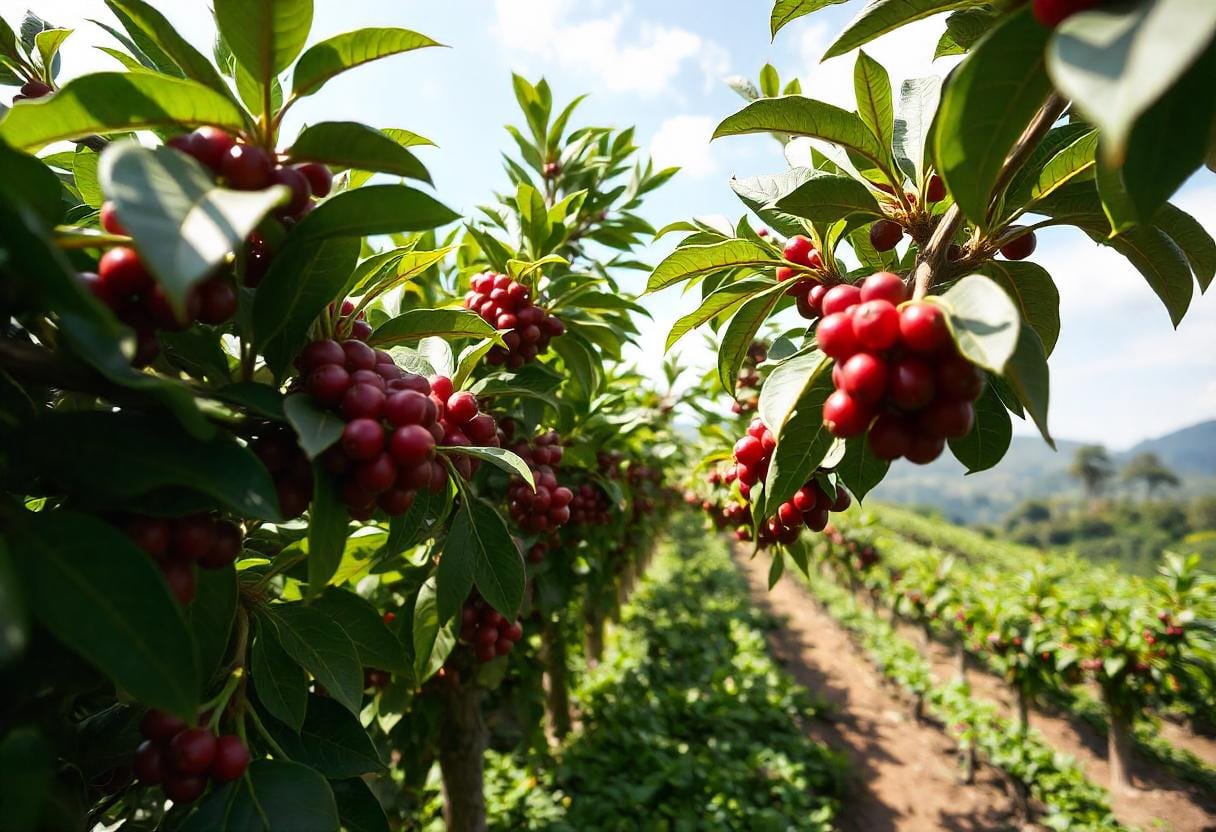
Cherries grow larger than those of most commercial species. The pericarp feels firm during mid-ripening. Color progression follows predictable steps across maturity. Pulp adherence affects depulping settings and throughput. Skin thickness requires adjusted equipment pressures. Therefore, processing lines adapt to fruit geometry and mechanical response of liberica coffee plant.
Seed Form and Endosperm Traits
Seeds appear elongated with pronounced asymmetry. The endosperm hardens as maturation advances. Screen sizes skew higher than arabica averages. Density distribution influences grading decisions and shipping mixes. Cut tests reveal structure uniformity and defect patterns. These factors inform sorting thresholds and storage policies across facilities.
Bark, Wood Density, and Root System
Bark shows distinct texture that thickens with age. Wood density supports resistance to breakage under wind stress. The root system anchors well in deep soil layers. It explores volume effectively under balanced moisture. Root vigor enhances uptake during peak demand. Hence, orchard designs include adequate spacing for structural expansion.
Cultivation Requirements of the Liberica Coffee Plant
This species shows clear environmental sensitivity across growth stages. Managers monitor temperature, water, and airflow with precision. They adjust canopy cover to maintain leaf temperature. They deploy mulch to stabilize soil moisture. They calibrate nutrition according to targeted yield bands. Under these controls, the liberica coffee plant maintains predictable performance.
Operations set thresholds for heat, drought, and storm exposure. They define irrigation triggers using soil moisture data. They target balanced nitrogen with micronutrient support. They time pruning to control height and light interception. They schedule weeding to protect root zones. With these steps, long-term outcomes remain stable and traceable.
Climate and Site Parameters
| Parameter | Preferred Range | Management Notes |
|---|---|---|
| Mean temperature | 22–30 °C | Use shade to limit leaf heat. |
| Diurnal range | 6–10 °C | Avoid sharp nighttime drops. |
| Relative humidity | 60–85% | Maintain airflow to limit disease. |
| Wind exposure | Low to moderate | Install windbreak rows. |
Soil, Rainfall, and Elevation Needs
| Factor | Optimal Condition | Practical Guidance |
|---|---|---|
| Soil texture | Loam to sandy loam | Ensure drainage and root depth. |
| Soil pH | 5.5–6.5 | Apply lime or sulfur as needed. |
| Rainfall | 1,800–2,500 mm yearly | Add storage for dry months. |
| Elevation | Sea level–800 m | Monitor heat load at lower sites. |
Agricultural Value and Commercial Use
Market roles depend on region, processing style, and quality targets. Some supply chains use this species for blending balance. Others value distinct aroma and body attributes. Breeders also access traits for resilience breeding. Nurseries support diversification plans for climate adaptation. Under structured management, trade outcomes remain consistent and auditable. Accordingly, the liberica coffee plant contributes to diversified portfolios.
Buyers evaluate size, density, and defect levels using standard protocols. They request lot data and traceability reports. Processors adjust equipment to handle larger cherries. They tune fermentation and drying steps to preserve integrity. Roasters test roast curves suited to seed structure. They document flavor outcomes with calibrated panels and instruments.
- Demand of liberica coffee plant arises from blending strategies that seek body and texture control.
- Orchard design benefits from windbreak capacity and canopy layering options.
- Disease tolerance offers risk reduction under humid, warm settings.
- Large seed size influences grading, packaging, and freight efficiency.
- Processing adaptations enable stable throughput and reduced mechanical loss.
- Varietal diversity of liberica coffee plant strengthens climate adaptation and supply assurance.
- Research value supports breeding for vigor and stress tolerance.
Conclusion
This guide compiles morphology, site needs, and market implications in one view. It avoids duplication and unclear claims. It presents classifications and operational steps for planning. It aligns with standard descriptors and field observations. It references accepted ranges and practical thresholds. Within this framework, the liberica coffee plant secures a defined, practical role.
Further study should follow current agronomy trials and genetic resources. Practitioners can consult credible databases and technical bulletins. They should track updates on disease management and propagation methods. They should verify local regulations and planting material sources. They may compare findings across regions and seasons. For foundational data, review World Coffee Research resources.
Explore liberica coffee stories on FNB Tech! From farm origins to unique flavors, perfect for curious brewers seeking something different today.

I’m Tania Putri, a passionate content writer who truly loves coffee and the stories behind every cup. For me, writing isn’t just about words it’s about creating connection. I specialize in SEO-friendly content that feels natural, human, and engaging, especially in the world of specialty coffee.
I enjoy exploring everything from origin stories and flavor notes to pricing insights and global coffee trends. Whether I’m writing about rare kopi luwak or Ethiopian heirloom beans, I always aim to blend strategy with warmth. Coffee inspires me, and through my writing, I love sharing that passion with others.
Tags: coffea liberica plant Liberica coffee beans liberica coffee characteristics liberica coffee cherries liberica coffee cultivation liberica coffee farming liberica coffee growing regions liberica coffee leaves liberica coffee origin liberica coffee plant liberica coffee tree liberica vs arabica coffee liberica vs robusta coffee rare coffee varieties tropical coffee plants